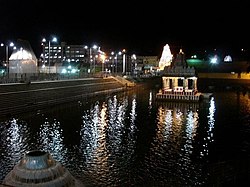
An Amazing Miracle Of Lord Venkateswara Of Tirumala Tirupati

This truly amazing and the most unbelievable miracle occurred almost three and half decades ago in the holy abode of Lord Sri Venkateswara of the Tirumala Tirupati temple located on a hill top in the Southern part of India…This great miracle still surprises many and is still a mystery to many so called atheists of our modern times.. This miracle not only endorses the divine existence of God but it also very emphatically approves our faith in Him…
But Where Is Tirumala Temple And Who Is Lord Sri Venkateswara ??
Located on top of a hill,853 meters above the sea level,Tirumala (Tiru means holy and Mala means hill) is a major pilgrimage center near the Tirupati town in the Chittor district of Andhra Pradesh,India..Spread over an area of 10.33 square miles,the Tirumala hill shrine consists of seven hills namely Seshadri, Neeladri, Garudadri, Anjanadri, Vrishabhadri, Narayanadri and Venkatadri… The main temple of Tirumala lies on the seventh hill called Venkatadri,which is why this holy Temple is also known as “The Temple Of Seven Hills”.

Lord Sri Venkateswara,also known as Balaji and Govinda, is the presiding deity of this holy Tirumala Temple and if we go by the statistics,about thirty to forty million pilgrims from all over the world visit this holy temple every year making Venkateswara the most worshiped Hindu God in the world and the temple of Tirumala the most visited place of worship today..
With its annual revenue running into billions of Indian rupees,Tirumala is also the richest pilgrimage center of faith in the modern world.
The Amazing Miracle
This truly amazing miracle occurred,in the holy temple of Tirumala,on the mid night of 7th November,1979..At that time,right from a street urchin to the holy Lord,the whole of Tirumala was in a deep sleep.. All the otherwise busy streets of the famous temple town were wearing a vacant look.. Except an occasional sound here and there,the whole of the Tirumala hill shrine,at that time,was filled with absolute silence..And exactly during that dark hour..Breaking all the silence..This miracle occurred and occurred so suddenly,taking the entire seven hills of the Tirumala hill shrine by surprise.
Thong…Thonggg…Thonggggg..
The huge Bronze bells,that were hanging in front of the principal deity of Lord Sri Venkatewsara in the holy Bangaru Vaakili(Sanctum Sanctorum)of the Tirumala Tirupati temple started ringing on their own without anyone touching them,sending waves of heavy metal sound across the whole of the Tirumala hill shrine.
The security staff,the police,the pilgrims,the officials,the temple staff,the Archaks and the Purohits,who were shocked by the huge sound of the Bronze bells,woke up startled and came running to the main Temple.

They all stood there outside the temple,watching in utter shock and confusion,trying to figure out how the huge bronze temple bells hanging in the heavily guarded and fully locked up Bangaru Vaakili (Sanctum Sanctorum) could ring on their own,without any one touching them..Shocking them further,the bells rang in that fashion for about five minutes and later stopped on their own…
It was a dream state for all those gathered there; an unbelievably true state.
Mysterious..Miraculous..And absolutely fantastic..
The entire Temple staff gathered there knows pretty well that all the doors of the main temple,including those of the Sanctum Sanctorum,will be fully locked up from outside after the Ekanta Seva (Final pooja performed in the temple every night) is over and there’s no way any one could enter inside until they are opened again for the Suprabhata Seva (First pooja offered to Lord Sri Venkateswara) the next morning..
Then how did the bells ring and who is there inside the Sanctum Sanctorum except the Lord Sri Venkateswara Himself..??
Several questions were raised,several doubts were discussed and several more inferences were drawn,but none of those gathered there could come out with a clear logical explanation.
Finally,they all came to a conclusion that some pilgrim,by mistake,was locked up in side the main temple and he must have banged those Bronze bells just to draw the attention of the temple staff.
Well.. That seems logical.. At least in a human point of view..
But if that was the case why would we call it a miracle and where is the need to write about it,now,after thirty two years..????
RIGHT..??
Then…What Happened..???

Why did that miracle occur.. ?? And what was its significance…???
To know that,it’s important for us to go back in time and know about a series of crisis ridden incidents that took place on the hill shrine of Tirumala a few weeks prior to the occurrence of this miracle.
The temple town of Tirumala,in those days,was witnessing a never seen before water crisis that forced the temple staff to impose sanctions on the daily water consumption there on the hill shrine…As a result,the supply of water to all the employees’ quarters and pilgrim’s cottages was restricted..However,that could only regulate the water supply to a certain extent but failed to offer any solid solution..
Nevertheless the water levels,in the Gogarbham reservoir and Alwar tank on the hill shrine,were drastically receding..A few more drinking water wells that were there on the Tirumala hill too were drying out (The current Papa Naasanam reservoir was under construction then)
An Emergency Meeting Of The Tirumala Tirupati Devasthanam Board
Greatly disturbed by the acute water crisis,P V R K Prasad,the executive officer of the Tirumala Tirupati Devasthanam Board,immediately called for an an emergency meeting of his think tank to discuss the measures to combat the on going water crisis in Tirumala…
He had a marathon discussion with his water board engineers.
The engineers pleaded complete helplessness and in turn warned the executive officer,saying “the tanks and reservoirs on the Tirumala hill have very little water reserves that can only be served for a very limited period of time..”
At length they discussed about various other options to withstand the water crisis…Every one suggested that more sanctions should be imposed on consumption of water on the hill shrine…
In those days, in addition to twenty five thousand visitors per day,the holy temple town had around six thousand population living there..Water sanctions were already being imposed to the maximum level and any further sanctions will only paralyze the human life there…So no further sanctions.
Then,what..???

Someone suggested to put a restriction on the number of pilgrims visiting the holy hill shrine…It is then that then that the executive officer said..”most of the pilgrims who visit Tirumala plan their trip months in advance..It would be cruel and unfair to stop them now.. Secondly,there is no such legislation to prevent any devotee of Lord Sri Venkateswara from visiting the holy shrine.”"Even otherwise,we are here to serve His devotees but not to put restrictions on their visits..”. He concluded.
Problem back to square one as the crisis started deepening with every passing day.
The Crucial Meeting With A Noble Saint
As an ardent devotee of Lord Sri Venkateswara and as the official head of the holy Tirumala Tirupati Devasthanam Board,the executive officer PVRK Prasad decided to find a solution to the water crisis on his own…He has great faith in the holy scriptures of Vedas and Upanishads and also knows that they offer a definite solution to every human problem..
“But who is the competent person to offer guidance on the Vedas and Upanishads and who will give proper direction to the Tirumala Tirupati Devasthanam board on that aspect..???” is the million dollar question here..
After due consultations with eminent personalities in the field of spirituality, the executive officer PVRK Prasad decided to seek final guidance from Sri.Uppuluri Ganapati Sastry,a holy personality and an authentic authority on all topics related to Vedas,Dharmas,Dharma Sastras and Upanishads.
Sri.Uppuluri Ganapati Sastry was a saintly man of eighty years of age and was an adviser to the Tirumala Tirupati Devasthanam Board and many other dharmic organizations those days. He had followers and disciples all over the world and they very reverentially consider him a reincarnation of Hindu Goddess Saraswati.
Sri Satsry has spent forty eight years of his life time in learning Vedas and Upanishads..Apart from attaining complete mastery over Vedas, Sri Sastry had also attained greater command on the Vedangas (Sub Branches of Vedas) namely Vyakarana, Tarka, Meemansa, Nyaya, Nirukta and some other branches of the Vedas.By far he is the only Indian master empowered with so much authority on Vedas,Upanishads and other major Dharma sastras.He was also the recipient of the prestigious Padma Vibhushan award from the Indian government.
PVRK Prasad met Sri.Uppuluri Ganapati Sastry in his Secunderabad residence and explained to him in detail about the water crisis in Tirumala. After carefully listening to all the woes narrated by PVRK Prasad, Sri Sastry smiled and said..
“Dear Prasad,Indeed there is solution to every human problem in the Vedas.. In fact,people in olden days depended entirely on the Vedas and Vedic rituals for their problems.. With utmost reverence and with complete faith they followed the scriptures laid down by the Vedas and have found solutions to many such problems.”..
PVRK Prasad was noting down all the points…
Sri Sastry continued..
“Even during acute water crisis and famine,people in olden times have performed Varuna (God of Rain) Japam and enjoyed the benefits of rain… But in these modern days of sin filled world who has belief in Vedas and who will perform Varuna Japam,that too,with so much discipline and faith..?? If you are prepared to do that Prasad with all the spiritual discipline required,then I am here to guide you and give you the Rithviks (Brahmins or the officiating acharyas who perform holy religious activities on behalf of their spiritual master) to perform the holy Varuna Japam…It has given positive results earlier and am sure it will deliver the same now too..”
Commencement Of The Holy Varuna Japam
After carefully noting down every point mentioned by Sri Sastry, PVRK Prasad decided to immediately perform Vauna Japam (A divine and holy ritual performed to appease the Rain God of Varuna) in Tirumala,in accordance with the scriptures laid down in the Vedas..He was determined, come what may,to follow Sri Sastry’s instructions..He took blessings from the noble saint and left for Tirumala.
Later things followed in quick succession.
In view of his old age,Sri.Uppuluri Ganapati Sastry excused himself from personal attendance but he however promised to offer all the necessary help to Prasad to successfully complete the Varuna Japam..
Later Sri Sastry identified a few Rithviks and instructed them to go to Tirumala to carefully organize and conduct the holy ritual.
After doing all astrological calculations, PVRK Prasad decided to conduct the Varuna Japam on 1, November,1979…
But unfortunately the Rithviks who were to conduct the Varuna Japam could not come to Tirumala on time owing to several genuine reasons.
As a result..
The Varuna Japam was indefinitely postponed
A couple of days have passed…
In the mean time the water crisis deepened further.
Pleading total helplessness,the Tirumala Tirupati Devasthanam engineers informed PVRK Prasad that it will be impossible for them to supply water for more than a week..
“And if that happens”, they warned
“Tirumala has to be closed down indefinitely..”
And in such case of an indefinite close down,PVRK Prasad as the head of Tirumala Tirupati Devasthanam will then go down in the history as its most unpopular executive officer…
With a blazing Sun rocking the holy town of Tirumala and with no signs of any clouds nearby,PVRK Prasad was a disturbed man..
“What to do..??”..Several questions were battling in his mind..
Without wasting any time,he immediately called everyone and personally spoke to all the Rithviks and decided to perform the holy Varuna Japam at the earliest..
They all have discussed at length about a few more problems and a few more hurdles.
However,PVRK Prasad made his stand very clear and decided to perform the Varuna Japam on the 8th of November, 1979..
After everyone left, PVRK Prasad silently offered his prayers to Lord Sri Venkateswara “Swamy Venkateswara…as Your humble servant I always wish to do my best for You and Your devotees..Then why these hurdles..??And what is this ordeal..?? I need Your guidance and I need Your approval..Please offer help”
Will the Lord Sri Venkateswara offer His approval..?? If so how..??
Although everyone swung into preparations immediately.there were,however, still some doubts in everyone’s mind..
Though very confident,an anxiety filled PVRK Prasad too was very eagerly waiting for an approval from Lord Sri Venkateswara..
It was then…
During that dark hour on the mid night of 7th, November, 1979…
Just a few hours before the commencement of the Varuna Japam..
The heavy Bronze bells,hanging in front of the principle deity of Lord Sri Venkateswara,rang on their own..
Signalling Lord Venkateswara’s much awaited permission and signalling HIS most wanted approval for the Varuna Japam..
That was an amazingly mind blowing miracle of Lord Sri Venkateswara very difficult for the humanity to understand..

PVRK Prasad was dumb founded and speechless..
Later,for three full days, amidst chanting of the Vedic hymns,the holy Varuna Japam was performed strictly according to the Vedas and strictly according to the instructions given by the noble Sri Uppuluri Ganapati Sastry.. After that,once all the rituals of Varuna Japam were completed on the third day,it was supposed to rain immediately ..